
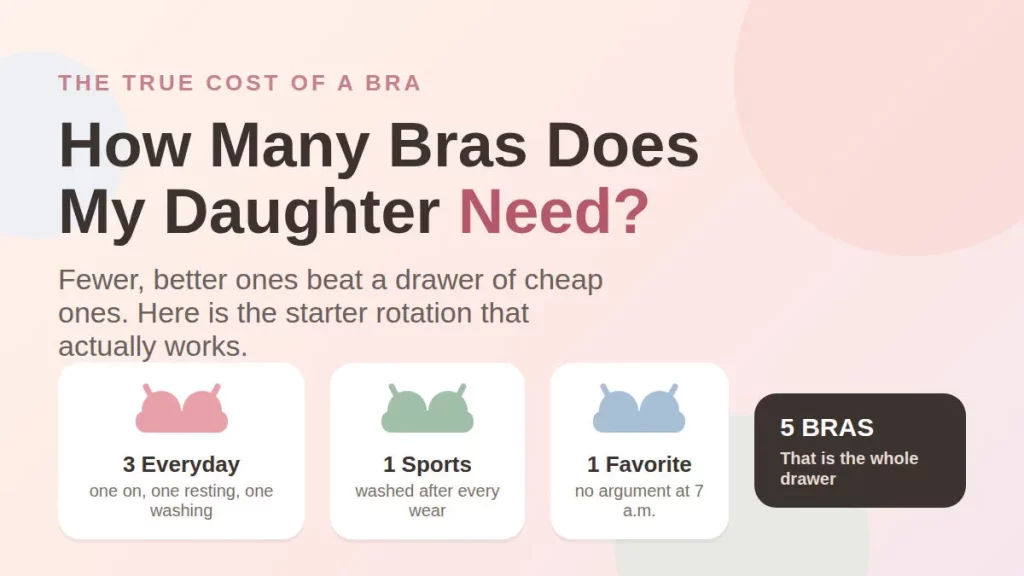
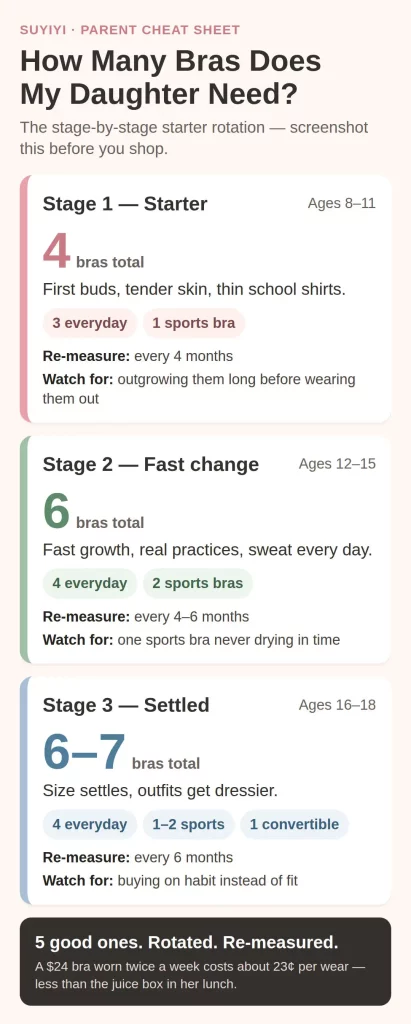
How many bras does my daughter need? Five. Maybe six if she has practice on Tuesdays and Thursdays.
I know that number sounds low. You’re standing in the aisle with a three-pack in one hand and one nice bra in the other, doing math in your head. Will she even wear them? Will she outgrow them by spring? Is paying more for one honestly worth it when the pack is right there?
Here’s the part most of us never get told. The number in the drawer matters less than whether those bras fit, hold up, and get rotated. Buy the wrong five and you’ll be back in that aisle in six weeks. Buy the right five and you may not shop again until she grows.
Start Here: The Starter Rotation Every Tween Actually Needs
The starter rotation is three everyday bras, one sports bra, and one she picked herself. That’s it. That’s the drawer.
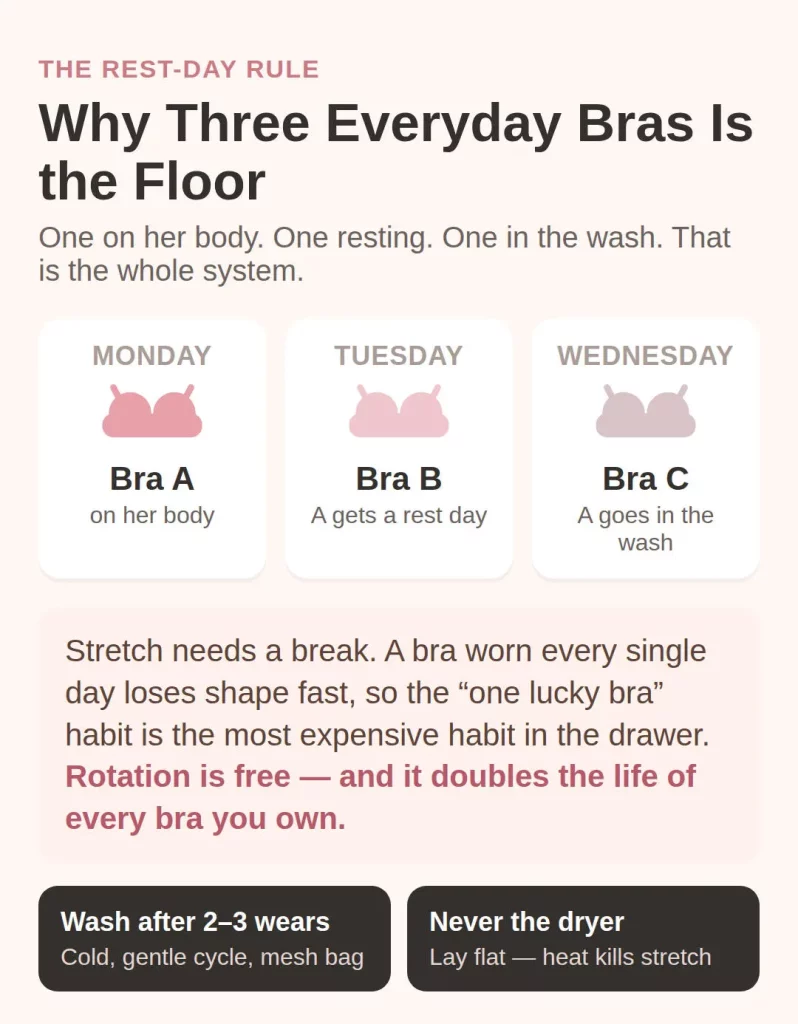
Three everyday bras works because of how laundry actually runs. One is on her body. One is resting so the stretch can bounce back. One is in the wash. Skin doctors give the same plain advice about rotation and washing, and you can read the wash timing in detail here.
The fifth bra is not a joke. It’s the one she loves. Softest one, best color, no argument at 7 a.m. That peace is the thing you’re really buying with the fifth bra.
Cost Per Wear: The Math That Changes Everything
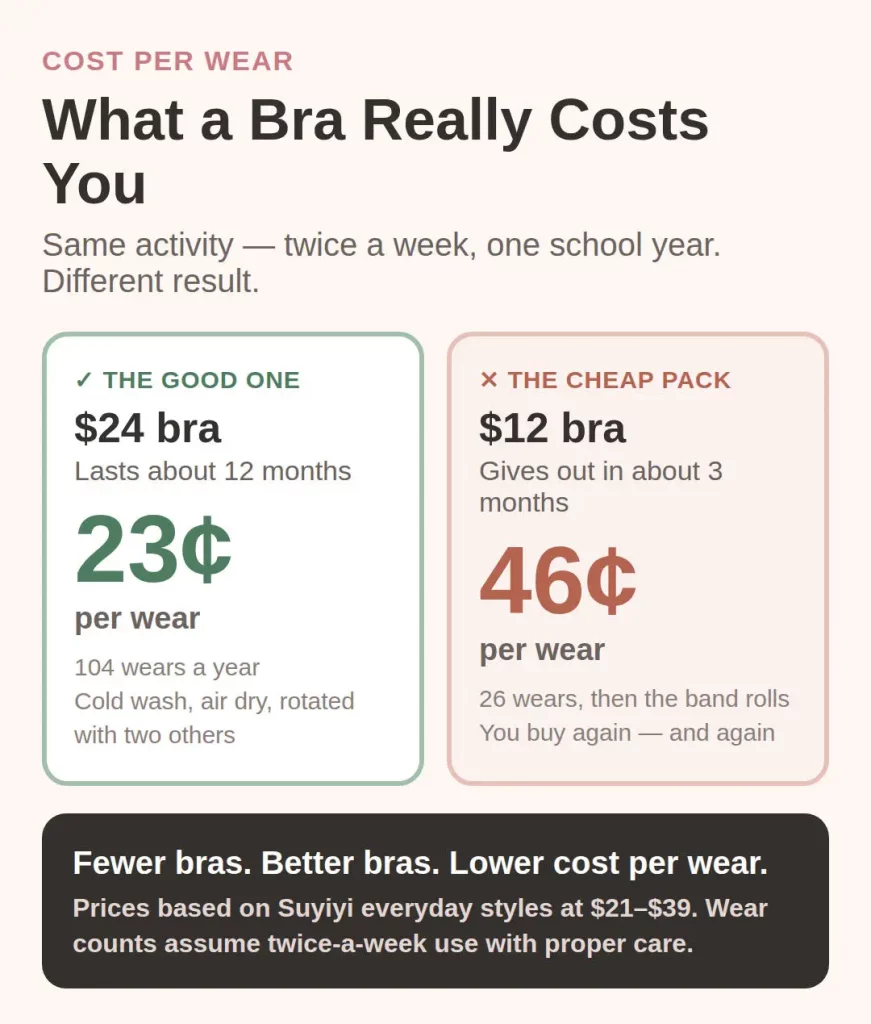
Let’s use real numbers. Our bras run $21 to $39, and most sit around $24 to $30.
Take a $24 bra she wears twice a week. That’s 104 wears in a year. Divide it out and you get about 23 cents per wear. Less than the juice box in her lunch bag.
Now line that up next to the cheap pack. The three-pack wins at the register. They lose by week six, when the band rolls, the straps go slack, and she starts saying they “feel weird.” Cheap stretch gives out faster. Then you replace them. You paid twice for one year of bras.
Wrong sizing is the other money leak hiding in plain sight. Research keeps finding adult women getting this wrong at high rates — one UK study found most women sized their band too big and their cup too small, even after trying bras on. A badly sized bra is a waste at any price, so measure first and shop second. Our size guide walks through it in about two minutes.
Buy by Stage, Not by Size Alone
Stage matters because growth decides how long a bra gets used.
Stage 1 (ages 8–11): buy short, buy soft. She needs coverage and zero fuss. Soft fabric, wide band, no wires, no scratchy trim. Do not stock up in the next size up here — that backup stash is the classic budget mistake, because bodies don’t follow the calendar. If you’re shopping budget on purpose, start with our notes on where to buy training bras before you grab the first multipack you see.
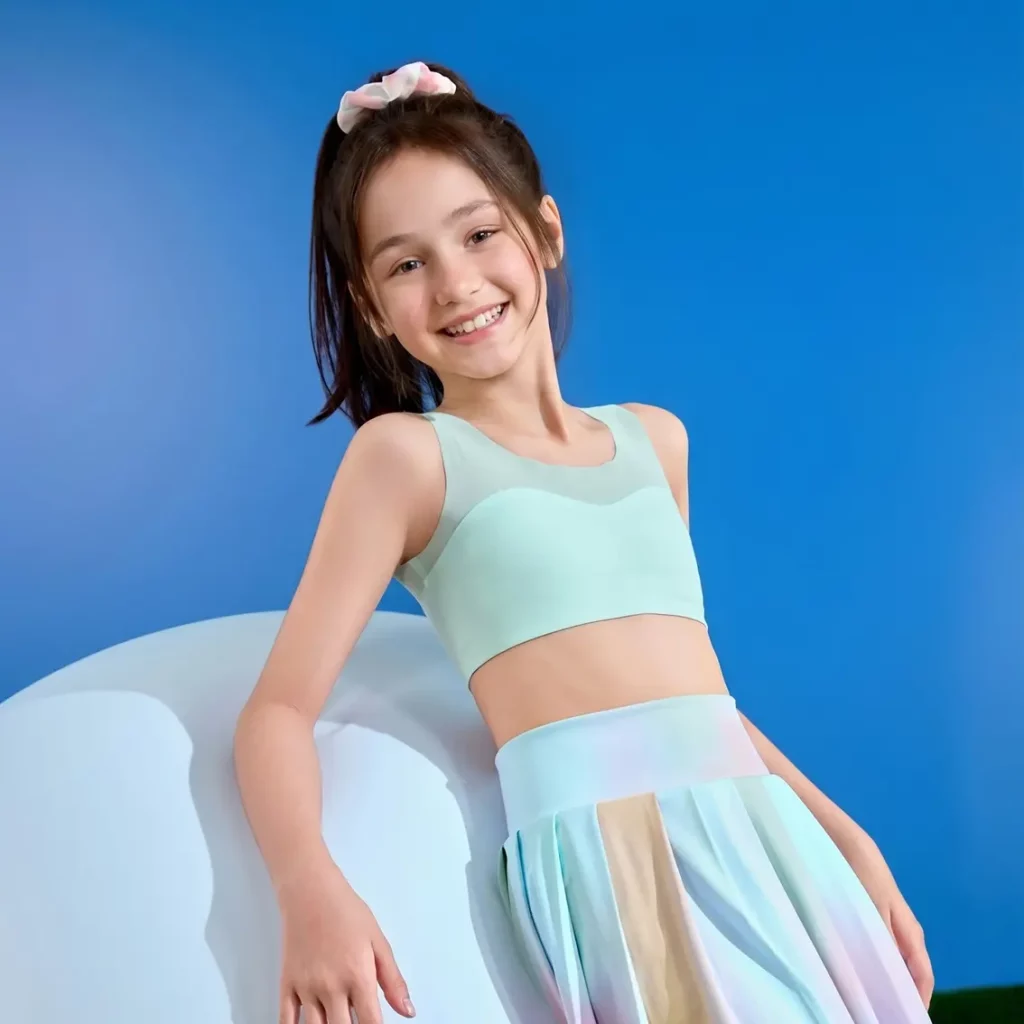
Stage 2 (ages 12–15): the sports bra bump. This is where most drawers fall apart, and it’s almost always the sports bra. Those get washed after every single wear, so one can’t cover a week with two practices and a game. It’s worth knowing why that matters beyond laundry: researchers studying girls and sport found that nearly half of schoolgirls said their breasts stopped them joining in physical activity. A dry, decent sports bra takes that excuse off the table. Our picks for sports bras for 12 year olds cover bouncing-heavy sports like track and basketball.

Stage 3 (ages 16–18): buy the good ones now. Growth slows, so what she buys today can last. This is the stage where quality pays you back the most, because air-dried bras in a steady rotation hold their shape far longer than anything tumble-dried.
Five Signs You’re Paying Twice for One Bra
False economy looks like a bargain right up until it doesn’t. These are the tells.
- The band rides up even on the tightest hook. Support is gone, whatever the tag says.
- Straps slide no matter how much you shorten them.
- Cups gape or wrinkle under a tee, so everything gets worn twice as long as planned.
- It smells a little off even right after a wash.
- Red marks on her skin that weren’t there when it was new and fade slowly.
If you spot two of these, you’re not owning a bra. You’re funding a replacement cycle.
Make Five Bras Last Twice as Long
Care is where budget-minded moms win. Hook the clasps, use a mesh bag, wash cold on gentle, then skip the dryer and lay flat. Heat is what ruins stretch fastest. Store them flat too, instead of rolling one cup inside the other.
Rotation does the rest. A bra worn two or three days apart recovers between wears. One worn every single day dies young. Our bra washing and drying guide has photos of each step if you want to show her.
There’s also a bigger reason to run a small drawer. Americans sent 11.3 million tons of textiles to landfill in a year, and only a slice got recycled. Fewer bras, kept longer, is simply less into the trash and less out of your wallet.
FAQs
How many bras does my daughter need for school alone?
Four works for most girls who don’t play a sport. That’s three everyday bras rotating through the week plus one spare for the day laundry doesn’t get done.
How many sports bras does a 12-year-old need?
Two minimum, three if she trains most days. Sports bras go in the wash after every wear, so one can’t keep up with a real practice schedule.
Should I buy the next size up to save money later?
No, especially in Stage 1. Growth can stall or spike, and a stash of bras she can’t wear yet is money sitting in a drawer. Buy for the body she has this month.
How often should I re-measure her?
Every four months during Stage 1 and Stage 2, then every six months once things settle. Pair it with a phone reminder so it actually happens. You can read up on the changes beforehand in our breast development stage guide.
Is one expensive bra really better than a cheap multipack?
On cost per wear, yes. A $24 bra worn twice a week costs about 23 cents per wear. A $12 bra that gives out in two months costs you more and annoys her more.