
Is a breast lump in a tween normal? Most of the time, yes. That answer is the one moms rarely hear fast enough.
A mom I talked to last month found a small lump on her 10-year-old while they were shopping for sports bras. She spent two nights awake reading search results. Her daughter was fine. The lump was a breast bud, which is the first step of puberty and not an illness at all.
Let’s walk through what typical breast development feels like, how to build a simple know-your-normal habit, and the few signs that really do need a call to the pediatrician.

Why a Breast Lump in a Tween Is Usually Just Growth
A tween’s chest is under construction. Building work leaves lumps behind.
The first one has a name: a breast bud. Doctors call it thelarche, and it is the earliest sign of puberty in girls. It sits right under the nipple, feels firm and rubbery, and can be sore when touched. Most girls get one between ages 8 and 12, and age 7 can still be normal, according to the American Academy of Pediatrics’ breast symptoms guide for children.
Timing varies a lot. In a study of more than 1,200 girls published in Pediatrics, the middle age for the first breast bud was 8.8 years for African American girls, 9.3 for Hispanic girls, and 9.7 for white and Asian girls.
The other side usually follows within three months. That little bud grows into the whole breast over about two or three years, and the first period tends to arrive roughly two years after the bud shows up.
One rule is worth taping to the fridge: any lump under the nipple area is a breast bud until a doctor says otherwise. Breast buds carry no risk of turning into cancer.
The other common lump is a fibroadenoma. It is benign, it feels smooth and rubbery like a marble, and it rolls when you push it. Fibroadenomas account for about 68% of all breast masses in teens, and roughly 2.2% of adolescents get one, per this review of adolescent fibroadenomas.
Asymmetry and Tenderness Come With the Territory
Here is the part that surprises moms most. Two breasts on one kid are rarely the same size.
One side buds first. One side stays bigger for months, sometimes years. That uneven phase is normal, and it usually evens out as development finishes.
Tenderness is normal too. Growing tissue is sore tissue. A bump against a backpack strap, a day of gym class, or the days right before a period can all make her chest ache. The soreness fades as the cycle moves on.
This is also the stage where a bra starts to matter for comfort, not looks. Soft, wire-free coverage keeps sore buds from rubbing on a t-shirt seam. Our guide on when girls need training bras covers the signs that she’s ready.
The Know-Your-Normal Habit Beats a Monthly Exam
Breast self-awareness for teens does not mean a formal monthly exam on the calendar.
The American Cancer Society stopped recommending routine monthly breast self-exams. Research showed they led to extra worry and extra biopsies without saving lives. What the ACS early detection guidelines recommend instead is simpler: know how your breasts normally look and feel, and report any change to a doctor.
For a tween, keep it tiny. Five checks, once a month, tied to something she already does.
- Where is it? Under the nipple is most often a breast bud.
- How big is it? Pea, coin, or marble. Say it out loud and write it down.
- Does it move? Lumps that roll are usually fine.
- Does it hurt? Sore is common. Pain plus hot, red skin is not.
- Is it changing? Growth over one full month is worth a note.
Keep those notes in your phone. Date, side, size, feel. Bring them to the appointment and the visit gets shorter.
What a Normal Tween Breast Lump Feels Like vs. What Needs a Call
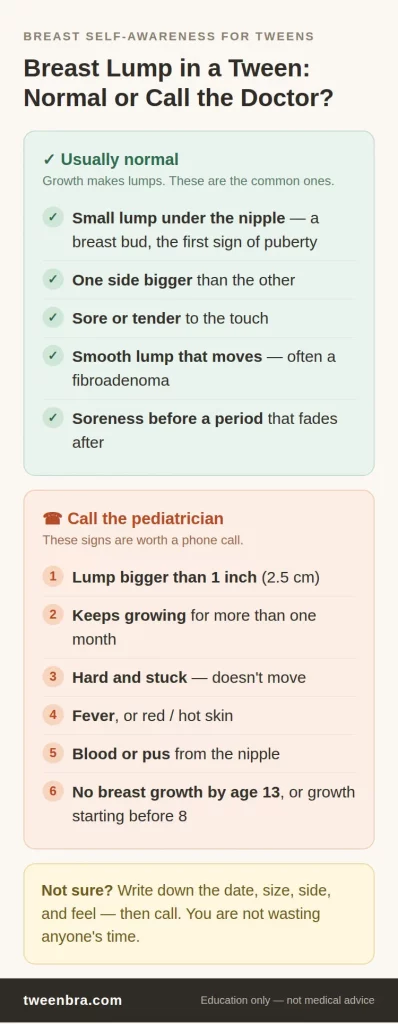
- Usually normal: a small lump under the nipple (breast bud), one side bigger than the other, soreness to the touch, a smooth lump that moves, soreness before a period.
- Call the pediatrician: a lump bigger than 1 inch (2.5 cm), a lump that keeps growing for more than a month, a hard lump that doesn’t move, fever or red/hot skin, blood or pus from the nipple, no breast growth by age 13 or growth before age 8.
Red-Flag Signs: Pick Up the Phone
Most breast lumps in kids turn out to be nothing. These signs are the ones worth a call.
- A lump larger than about 1 inch (2.5 cm)
- A lump that keeps growing for more than one month
- A hard lump that feels stuck in place and does not move
- Red or hot skin, or a fever alongside the lump
- Blood or pus coming from the nipple
- A dimple in the skin, or skin that looks like an orange peel
- A new lump in the armpit
- No breast growth at all by age 13
Trust your gut here. You are not wasting anyone’s time.
What Happens at the Doctor’s Office
Most of these visits are short and boring, which is the best outcome.
The doctor examines the area and asks questions. If imaging is needed, the first choice for kids is ultrasound. It uses sound waves, no radiation, and it works well on dense young breast tissue. Mammograms are usually skipped at this age.
Ultrasound is also reliable. When radiologists use the Stavros criteria, a mass called benign on ultrasound turns out to be benign almost every time.
Biopsy is rare. A 2019 study of 277 teen breast lumps that looked like fibroadenomas on ultrasound found all of the biopsied ones were benign, and the authors recommended against routine removal. Most kids leave with a plan to watch and wait, plus a follow-up scan in 6 to 12 months.
How Moms Can Bring It Up Without Fear
Kids read your face before they hear your words.
Keep your voice flat and your sentences short. “Your body is growing. This is a growth bump.” Then stop talking and let her ask. If you keep checking her chest every night, a normal body starts to feel like a problem.
Try these lines:
- “It’s sore because it’s new. That part goes away.”
- “Most lumps in girls your age are just growth.”
- “We’ll ask the doctor so we know for sure.”
Never squeeze or rub a breast bud. That can drive bacteria in and cause an infection that needs antibiotics.
A bra fitting gives you a natural opening for this talk, since you’re already looking at fit and comfort together. Our first bra fitting tips walk you through it step by step.
Comfort Helps While She’s Growing
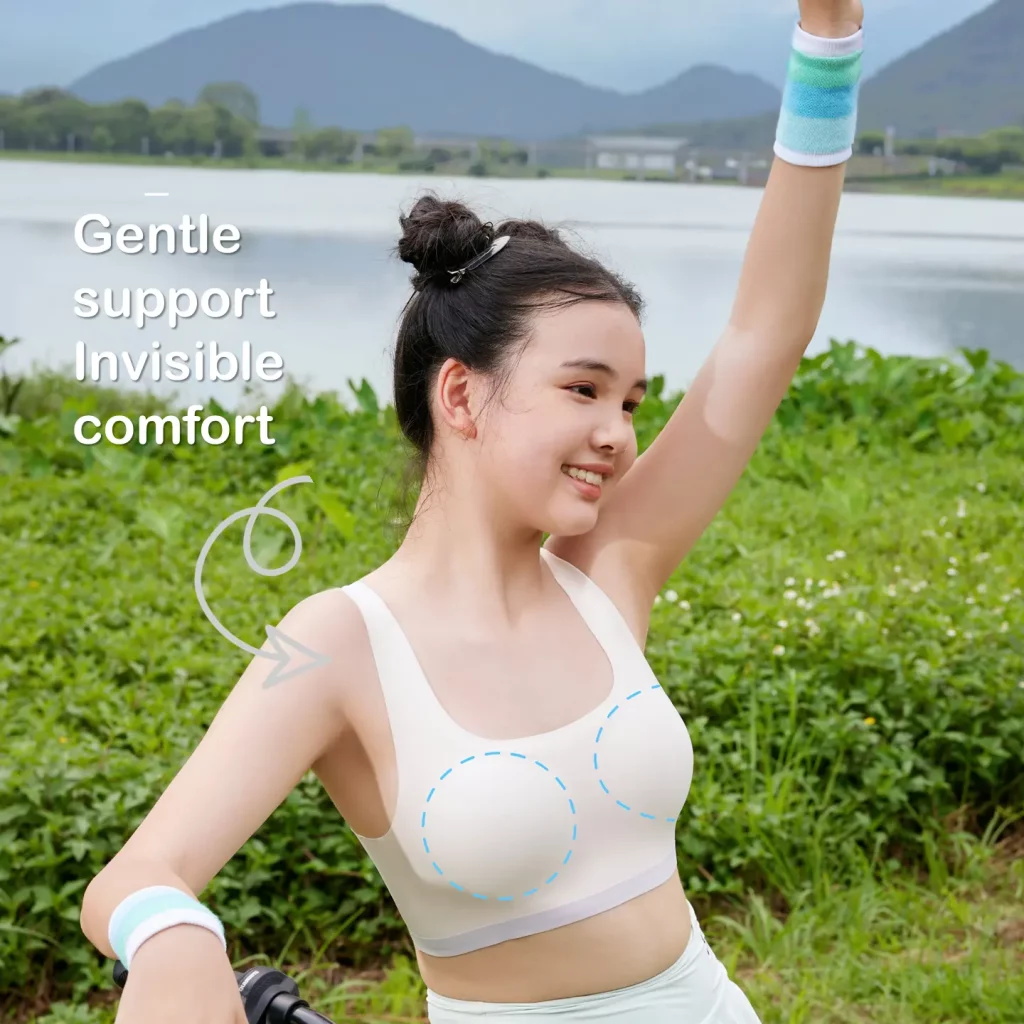
Sore, growing breasts do better in soft fabric. Skip anything with a wire, a scratchy seam, or a tight band while she’s in the bud stage. Breathable fabrics and a wide, flat band take pressure off tender spots.
FAQs
Is a breast lump in a tween normal?
Yes, most of the time. The two most common causes are breast buds and fibroadenomas, and both are benign. Breast buds sit under the nipple and mark the start of puberty.
What does a breast bud feel like?
Small, flat, and firm, like a coin under the nipple. It can be tender. It often shows up on one side first, and the other side usually follows within three months.
Can a breast bud turn into cancer?
No. Breast buds have no risk of becoming cancer, according to the American Academy of Pediatrics. Do not squeeze or massage them, since that can cause an infection.
Should my tween do monthly breast self-exams?
No formal exam is needed. Body awareness is the goal. She should know what her own chest feels like and tell you if something changes.
When should I call the pediatrician about a breast lump?
Call if the lump is over 1 inch, keeps growing past a month, feels hard and stuck, or comes with fever, red skin, or nipple discharge. Also call if breast growth starts before age 8 or hasn’t started by 13.
Does she need a special bra while her breasts are developing?
A soft, wire-free bra helps with soreness and chafing. Fit matters more than style at this stage, and it needs checking every few months as she grows.