
If you just searched “small bumps on nipple area puberty” at 11 p.m. after bath time, you’re in good company.
Your daughter stepped out of the shower, you caught a glimpse of the darker circle around her nipple, and there they were. Tiny bumps. Your stomach did that little drop it does when something looks new and you can’t name it yet.
Here’s the plain answer before anything else: those bumps are almost always normal anatomy. They have a name, they have a job, and they need nothing from you except being left alone.
I’d say the same thing at the kitchen table, so let’s keep it at kitchen-table level.
Small bumps on nipple area puberty: what you’re actually looking at
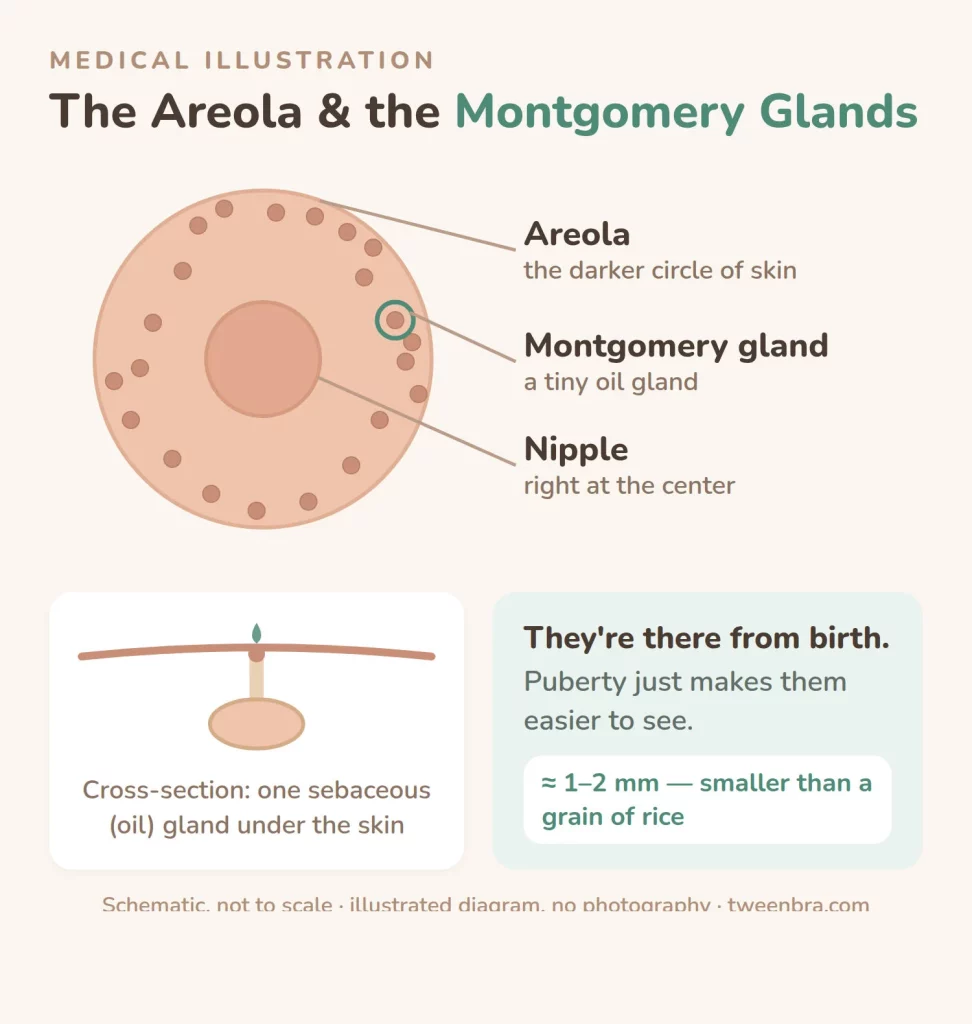
The darker circle of skin around the nipple is the areola. Say it ah-REE-oh-lah. The little bumps sit right on that circle, and a few sit close to the nipple itself.
They’re Montgomery glands. You’ll also see Montgomery tubercles, areolar glands, and glands of Montgomery in medical writing. Four names, one thing.
They’re sebaceous glands, the technical way to say oil glands. Cleveland Clinic has a clear page on Montgomery glands if you want the clinical version side by side.
They’ve been there since before she was born. Doctors can see them forming early in fetal development; they just don’t show on a baby’s skin.
Each one is about 1 to 2 millimeters across, smaller than a grain of rice. They’re round, smooth, a little firm, and the same color as the areola or a shade lighter.
Most people have somewhere between a handful and two dozen, spread out rather than clustered, with a few more on the upper outer side. A 2006 count in grown women went from 0 to 38 on one areola, so there’s no number to hit.
Here’s the part that trips moms up. Cold air, a warm shower, or a light touch can make them stand up for a minute, then flatten again. That’s why they seem to appear out of nowhere after bath time and look gone by bedtime.
Montgomery glands puberty: why they show up now
They don’t actually appear at puberty. They get easier to see. Estrogen rises, the areola widens and darkens a little, and the skin there is thin, so the glands sit closer to the surface.
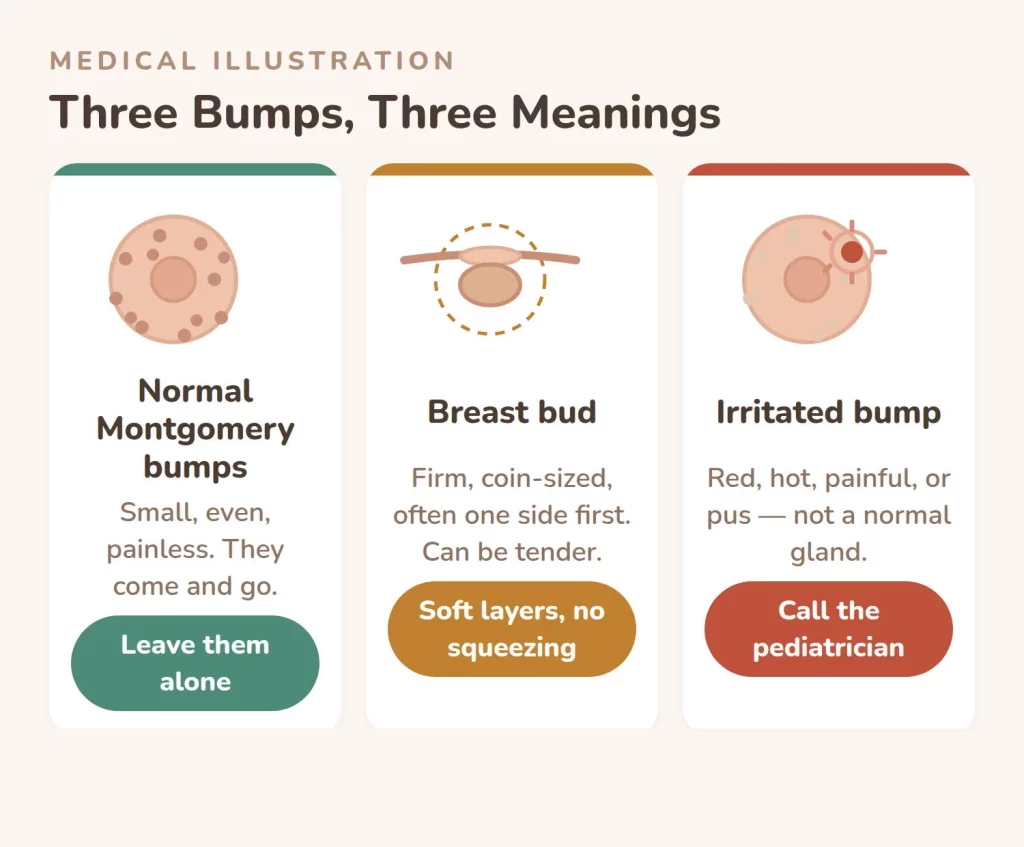
That’s the same stretch as the breast bud, a firm, nickel-sized lump right under the nipple that’s often the first sign of puberty. Doctors call that start thelarche. One side usually goes first, which worries moms every single time and is completely ordinary.
The American Academy of Pediatrics puts the usual start between 8 and 13, and its guide to girls’ physical development is worth a read if you want the full timeline.
A 2013 Pediatrics study followed 1,239 girls and found the middle age for the start of breast growth at 9.7 years for white girls, 9.3 for Hispanic girls, 8.8 for Black girls, and 9.7 for Asian girls. Body weight was a stronger factor than race.
So bumps on a 9- or 10-year-old areola line up with the calendar. They also line up with our guide to breast development for girls 8–11, which is the one I’d hand her to read on her own.
Later on, if she’s in the 12-to-15 stretch, our Stage 2 bras are built for faster growth and more movement.
What those bumps do all day
They make a small amount of oil, called sebum. That oil keeps the areola and nipple soft and helps hold the skin’s barrier together, which is a quiet way of saying it helps stop dryness and cracking.
It has a mild germ-fighting side too. Nothing dramatic, just one small part of how that skin protects itself.
For your daughter, none of that baby stuff is on the clock yet. Right now the oil is just skin care, and that’s the whole job.
Bumps around nipple normal: the 30-second check
Most of the time you can settle this at home with a look rather than a guess. Here’s the quick check I’d want if I were standing in your bathroom at 10 p.m.
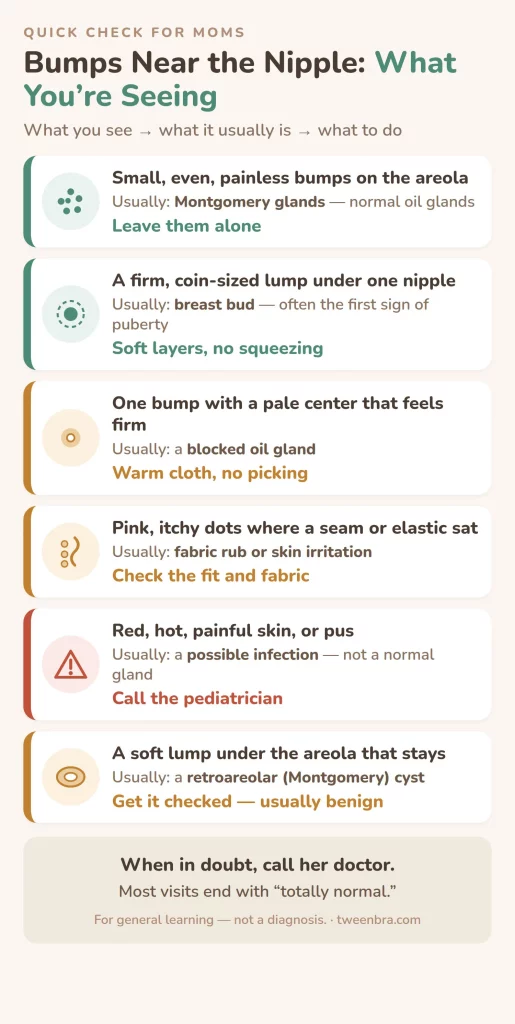
Six signs point to normal glands: small, even, no pain, no itch, spread out, and steady week to week. They also rise and fade with cold, touch, or a shower.
If the infographic lands you on the fabric-rub row, check our size guide first. A strap that’s too tight is usually the culprit.
What NOT to do (the part that actually matters)
This is the whole reason for the post. A bump that looks like a whitehead invites a fingernail, and that’s the one move that turns a non-issue into a real one.
- No squeezing. It can push germs in and start an infection.
- No picking or scrubbing in the shower, even if one looks ready to pop.
- No acne products, creams, or oils on the areola unless her doctor says so.
Leave them alone. That is the entire treatment plan. If one ever gets clogged and feels firm, a warm cloth is enough, and a clogged one often clears on its own.
Tell her the rule out loud, kindly: “These are just oil glands. We don’t pick them.” Kids who know the name are far less likely to fiddle with it. Naming normal anatomy is what keeps a mom from panicking and a kid from picking.
Areola bumps tween: other things that feel like bumps
Not every bump on a tween chest is a gland, and mixing them up is where the late-night searching starts.
Breast buds are firm, often one-sided, and can be tender. Flat or inward nipples show up in 10 to 20% of girls and are a shape, not a problem. A few dark hairs at the edge of the areola are common too.
Our Breast Self-Awareness for Tweens hub is built for exactly this: helping a girl learn what’s hers, what’s normal, and what’s worth telling you about.
A blocked gland or a small cyst behind the areola is still benign territory. A 2020 report followed two teens, 15 and 13, with Montgomery cysts; both got better with medicine and neither needed surgery.
A rash or heat bumps after practice tend to itch and spread out. Glands don’t itch, and they don’t show up in a patch where a strap sat.
When it’s a rash or an infection instead
Normal glands don’t get red, hot, or sore. When the skin around a bump changes, you’re looking at something else, and that’s a doctor question rather than a wait-and-see one.
- Redness, heat, swelling, or pain that sticks around.
- Pus, bleeding, or fluid that isn’t clear or oily.
- A bump that grows fast, or a lump under the areola that won’t go away.
Most of these turn out to be simple skin stuff. A visit still beats guessing.
If it looks like a rash along a seam or under elastic, our bra irritating skin guide is the one to open first. Fit and fabric are usually the whole story.
What to say to her
Keep it short and keep it boring. Boring is a gift here.
“These are little oil glands. Everyone has them. They keep your skin soft. They mean your body is growing on its own time.”
Let her ask, or let her not ask. Don’t stare, don’t make an event of it, and don’t hand her a mirror and a lecture. If the area feels tender, a soft first layer is often the only thing she wants.

FAQs
Are bumps around the nipple normal during puberty?
Yes, most of the time. Montgomery glands are oil glands on the areola, and they get easier to see as estrogen rises. Small, even, painless bumps that stay the same week to week are the ordinary kind.
Do Montgomery glands go away?
They don’t go away, they just change how much they show. Cold, touch, and hormone shifts make them stand out for a bit and then settle. Some people can always see a few, some can barely see any.
Can she squeeze one that looks like a whitehead?
Please don’t. Squeezing can push germs in and start an infection. A warm cloth is plenty if one feels clogged, and a doctor can look at anything that gets red or sore.
When should I call the pediatrician?
Call for redness, heat, swelling, pain that stays, pus, bloody or unusual fluid, a bump that grows fast, or a lump under the areola that hangs around. Most visits end with “totally normal,” which is a good use of an appointment.
Do boys get Montgomery glands too?
They do. Everyone has areolar glands. They’re usually less noticeable, and the same no-picking rule applies.
One last thing
Those bumps have a name, they have a job, and they don’t need a thing from you. So if small bumps on nipple area puberty ever send you back to a search bar at midnight, come back to this page and take a breath.