
If your daughter suddenly dreads the pool and says she feels tween self conscious in swimsuit moments are ruining summer, you are not imagining it, and neither is she.
Summer should feel easy. But for a tween whose body is changing fast, pulling on a swimsuit can feel like stepping onto a stage with no script. The good news? A little prep, the right fit, and some careful words from you can turn pool dread back into pool fun.
Why the Pool Feels So Exposing (And Why It Is Not Just Her)
For a girl who feels tween self conscious in swimsuit season, the pool is ground zero. Tween self conscious in swimsuit feelings peak here because everything feels on display at once.
Remember the last time you tried on a swimsuit under harsh fluorescent lights? Now imagine doing that at 12, with a body that feels new and unfamiliar.
Puberty does not follow a shared schedule. One girl has breast buds, another has a fuller chest, and a third sees no visible changes yet. All of these are normal. But when every friend seems to be on a different timeline, the pool becomes a comparison trap.
Swimsuits also show more skin than regular clothes. Water makes fabric cling, straps shift, and tops ride up. A tween who felt fine in jeans and a hoodie can suddenly feel watched, judged, and out of control.
Being shy sometimes is normal. The goal is not forcing her to “love” a swimsuit overnight. It is helping her feel safe enough to have fun.
Research backs this up. A long-term U.S. review found marked body dissatisfaction in about 24% to 46% of adolescent girls. A larger 2026 study confirmed girls report more body dissatisfaction than boys across age, country, and family background. So if your daughter is struggling, she is in good, crowded company.
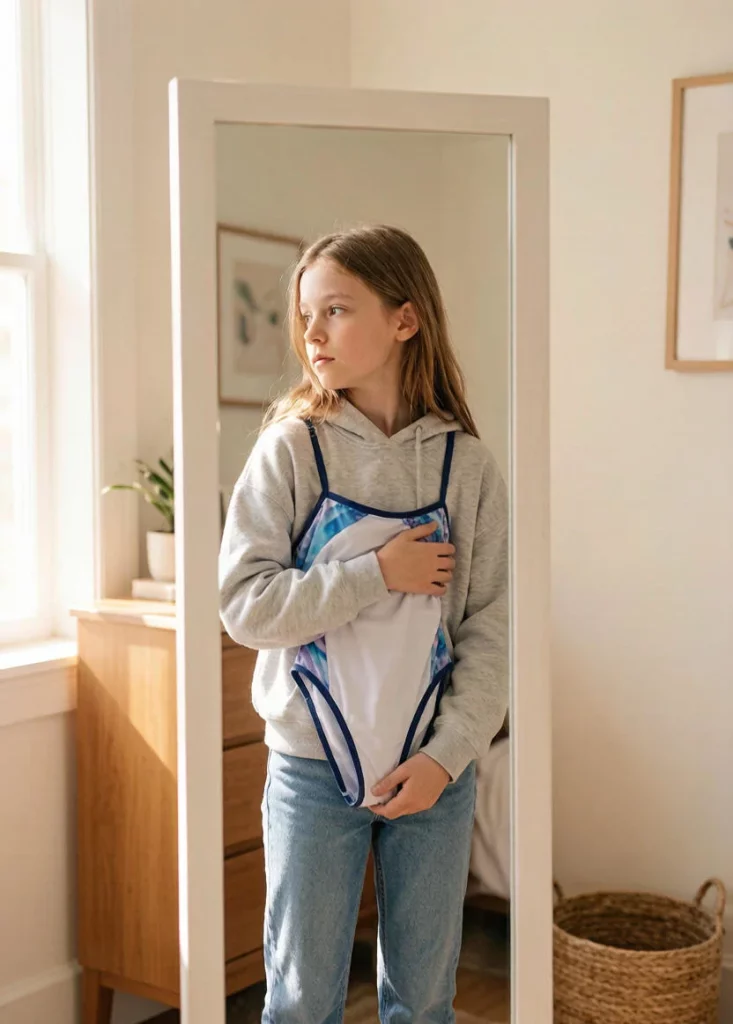
Picking a Suit + Bra Combo That Moves With Her
The right gear will not fix everything, but the wrong gear will absolutely make things worse. A suit that rides up, gaps, or slips is a daily reminder that her body is “wrong.” A suit that stays put lets her forget about it and just swim.
Tween Self Conscious in Swimsuit: What to Look For
The right suit passes a fit test (she lifts her arms without the top riding up, bends without pulling, takes a deep breath without pinching), offers coverage she controls (some girls want a higher neckline, others prefer a tankini or swim shorts, so let her lead), keeps straps that stay (wide straps tend to stay put better than thin ones when she is diving for pool rings), and adds a soft layer underneath if breast development has started (a gentle-coverage swim top or soft tween bra can cut down on that “exposed” feeling).
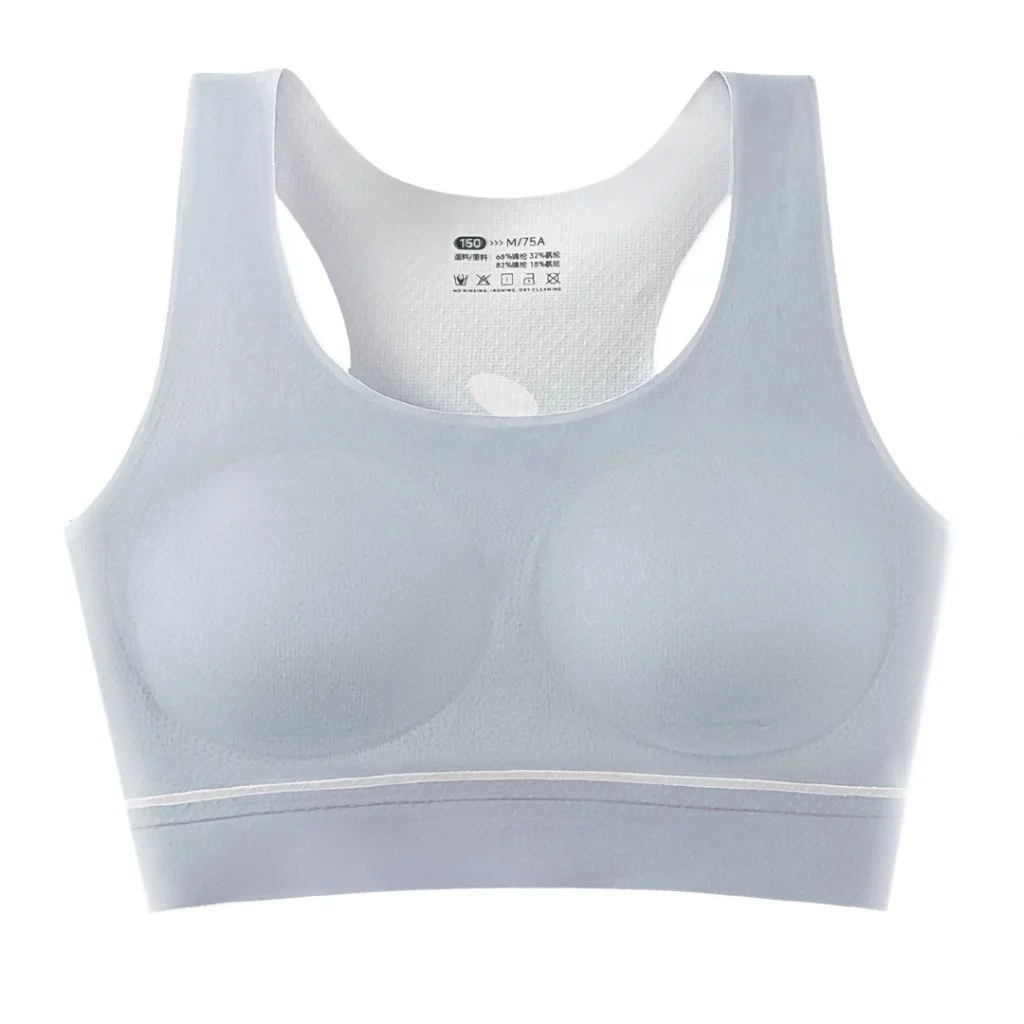
If she is in that rapid-growth Stage 2 window, a sports-style swim top can feel less like a bra and more like athletic gear she already trusts. That small shift in framing can be a big deal. For more on that in-between stage, check our sports bras for 12 year olds guide.
Swimsuit Options: Quick Compare
Here is a quick visual to help you talk through options together, not for her.
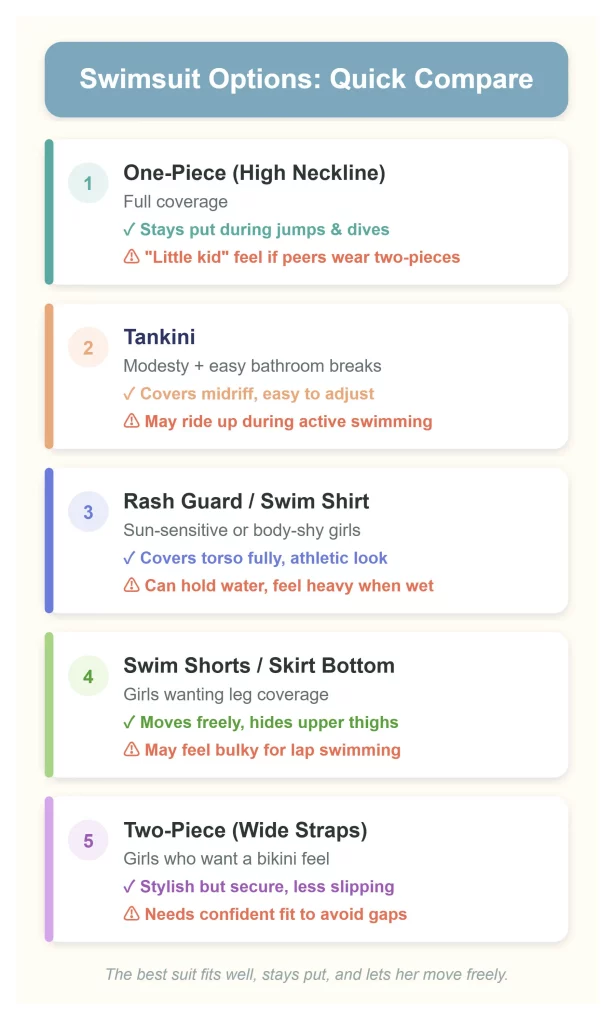
The “best” swimsuit is not one certain style. It is the one that fits well, stays put, and lets her move without worrying.
How to Do a Fit Check at Home
Before you ever head to the pool, turn her bedroom into a fitting room. Have her raise her arms over her head (does the top stay down?), bend over and touch her toes (any gapping?), jump in place a few times (does anything shift uncomfortably?), take the deepest breath she can (does anything pinch?), and twist side to side (does the suit twist with her or fight her?). If something feels off in her room, it will feel ten times worse at a crowded pool. Keep shopping.
A Pre-Pool Confidence Ritual for Moms and Daughters
Confidence is not a switch you flip at the pool gate. It is something you build at home, together, before the day even starts. Think of it as a small ritual you both can count on.
The Night Before
Lay out two or three suit options and let her pick. Choice builds ownership. While she decides, you can share a quick story about a time you felt nervous in a swimsuit. Normalizing the feeling takes the shame out of it.
The Morning Of
Make a small pool plan together. Keep it simple and concrete.
- Set one easy goal. Feet in the water for five minutes. That is a win.
- Pack her comfort kit. A cover-up she likes, a towel, dry clothes, and a favorite water bottle.
- Pick a quieter time if you can. Early morning or late afternoon lapses in crowd size matter.
- Plan an activity, not an appearance check. Water games, floating practice, hunting for pool toys.
- Agree on a break signal. A word or gesture she can use when she needs a breather, no questions asked.
What to Say Before You Leave
Your words stick. One study on family body talk found that adults’ negative comments about their own bodies, restrictive dieting, or remarks about a child’s appearance can all harm a child’s body image. So choose carefully.
Instead of advice, offer reassurance. Try lines like, “Your body helps you swim, laugh, and jump. That is pretty amazing,” or “You get to pick what feels good on you,” or “Swimming is for feeling strong and having fun, not for looking perfect,” or simply, “If you want a break, we take one. No big deal.”
And if you are working through the bigger picture of how she sees herself, our body image during puberty guide walks through the everyday moments that shape it.
What NOT to Say at the Changing Area
The changing area is a pressure cooker. It is loud, it is bright, and there are mirrors everywhere. Your daughter is already scanning for threats. What you say in that 90-second window matters more than you think.
Skip These Phrases
- “You look skinny.” Even compliments about thinness tie her worth to size. Praise what her body does, not how it looks.
- “You don’t need to worry.” This dismisses her feelings as silly. She does worry. Telling her not to will not help.
- “Just be confident.” Confidence is not a command. It is built through small wins over time.
- “Wear this, it looks better.” This teaches her that your opinion of her body matters more than her own comfort.
- “You’ll look fine if you lose a little weight.” Never. Linking body size to pool readiness is a fast track to shame and, over time, can feed disordered eating patterns.
Try These Instead
Swap the tough stuff for gentle, body-neutral lines. “That color looks fun on you.” “How does it feel when you move?” “Do you feel comfy in this one?” “Take your time. We are not in a rush.” “I am right here if you need me.” Notice how none of these are about how she looks. They are about how she feels.
Reframe the Mirror Moment
Most tweens catch their reflection and zero in on the one thing they hate. You can gently redirect that habit. Ask her to name one thing her body can do, not one thing it looks like. Remind her that mirrors at pools are tilted and lit to make everyone look strange. Point out that social media edits out the awkward angles — real bodies have rolls when they sit, skin when they bend, and that is just physics.
Social media pressure is real. A 2023 experiment on influencer images found that adult women who viewed them reported more negative mood, body dissatisfaction, and appearance comparison than a control group. Talk openly about filters and posing so she does not compare her real life to someone’s curated feed.
When Shy Becomes Something Bigger
A little pool nervousness is normal and usually passes. But sometimes it signals something deeper that needs more support.
Talk with her pediatrician or a mental-health professional if she stops going to swim, school, sports, or friend events because of her body, cries often about how she looks, skips meals or talks a lot about dieting, checks mirrors or photos over and over, says she hates her body, is being teased or bullied, or has big changes in sleep, mood, eating, or friendships.
Early support matters. Programs that teach body respect, health, and movement have been shown to improve how girls feel about their appearance. Getting help is not a failure. It is a parent doing her job.
Building Confidence That Lasts Past Summer
Pool season comes and goes, but how your daughter feels about her body is a year-round project. The pool is just where it gets loud.
Keep the focus on what her body can do. Swimming, running, dancing, climbing, laughing. Those are the wins worth naming. When she hears you praise effort and ability over appearance, she starts to internalize that message.
Keep conversations open and judgment-free. You do not need a perfect script. You just need to keep showing up.
And keep giving her choices. The suit, the style, the coverage level, the color. Small choices add up to a girl who trusts her own instincts about her body.
Tween self conscious in swimsuit feelings can soften. It takes the right fit, the right words, and time to grow at her own pace. With you in her corner, pool day can become something she looks forward to again.
Frequently Asked Questions
Is It Normal for My Tween to Suddenly Hate the Pool?
Yes, very normal. Puberty changes her body fast, and swimsuits show more of it than regular clothes. A girl who loved the pool at nine may feel exposed at twelve. The shift is about her body, not the water. Give it patience and the right gear.
What Is the Best Swimsuit for a Self-Conscious Tween?
There is no single best style. The best swimsuit is the one that fits well, stays put when she moves, and lets her forget she is wearing it. For many tweens, that means a one-piece with a higher neckline, a tankini, or a rash guard for extra coverage. Let her try a few at home and pick the one she feels safest in.
Should My Tween Wear a Bra Under Her Swimsuit?
If breast development has started, a soft swim top with gentle support can help her feel less exposed. Many tween swimsuits have built-in support. If hers does not, a lightweight sports-style swim top underneath can add a layer of comfort.
What Do I Do If She Compares Herself to Friends at the Pool?
Acknowledge it without feeding it. You might say, “I know it feels like everyone is looking, but most kids are just worried about themselves.” Then redirect to an activity. The more her brain is busy with a game, the less room there is for comparison.
How Can I Help Without Making a Big Deal Out of It?
Keep it light and practical. Do not stage a body-image talk at the pool. Instead, build confidence into everyday moments. Praise what her body does. Let her pick her own clothes. Model kindness toward your own body in her presence. Small, steady messages do more than one big conversation.
When Should I Worry That It Is More Than Just Shyness?
If she is skipping activities she used to love, crying about her appearance often, talking about dieting, or pulling away from friends, those are signs to take seriously. Talk with her pediatrician or a mental-health professional.