
Searching for how to respond when friends tease about body comments aimed at your daughter? A friend’s careless joke about her changing shape can sting worse than a stranger’s insult – because it came from someone she trusted.
Your daughter doesn’t need a lecture right now. She needs a plan: a short, rehearsed line she can pull out without freezing up, something that helps her stay steady when a friend says something thoughtless about her body.

Why Body Teasing From Friends Hits Different
Picture this: your daughter walks in after school, drops her backpack, and mumbles, “Sophie told me my chest looks weird in this top.” Your stomach drops. You want to fix it, make it go away, maybe march over to Sophie’s house.
That instinct is normal. But what your daughter needs first is for you to listen.
A classmate calling out her body is one thing. A friend doing it feels like betrayal. She might wonder, “Was I wrong to trust them?” or “Is something actually wrong with my body?”
Neither is true. Her body is doing exactly what it’s supposed to during Stage 2 development — growing, shifting, and finding its own rhythm. What’s wrong is the comment, not her body.
About 1 in 5 high school students report being bullied on school property, and more than 1 in 6 experience it online, according to the CDC. Body-related teasing is one of the most common forms kids encounter.

How to Respond When Friends Tease About Body: Start by Naming It
The first step isn’t a comeback line. It’s helping your daughter name what she felt.
Try saying something simple: “That comment stung, and that’s okay.”
No big production. No crisis mode. Just acknowledging the feeling so it doesn’t sit in her chest all day.
When you name the hurt calmly, you teach her that her reaction is normal – not something to bottle up or brush off. She doesn’t have to pretend it didn’t bother her.
This matters more than you might think. A 2022 research review of 79 studies found that teens who were teased or bullied were more likely to struggle with negative body feelings and unhealthy eating behaviors than those who weren’t. The connection is real, which is why responding early and at home makes a difference. You can read the full review on PubMed.
Then remind her of one thing that tends to sink in over time: their words say more about them than about you.
If body image has been a recurring worry for your daughter, our guide on body image during puberty goes deeper into building a positive self-view during these years.
Three Comeback Lines That Aren’t Fights
Your daughter doesn’t need to win an argument. She needs to shut the comment down and move on.
Here are three short lines she can rehearse with you until they feel natural:
- “Please don’t talk about my body.” – Direct, clear, and hard to argue with.
- “That wasn’t funny to me.” – Names the behavior without escalating.
- “I’m going to go talk to someone else.” – Removes herself without drama.
These lines work because they don’t invite a debate. Your daughter says her piece and moves. No explanation, no defense, no proving anything about her body.
If your daughter has been avoiding wearing a bra because of comments like these, that’s worth a separate, gentle conversation. You can read more in our guide on when your daughter refuses to wear a bra.
Practice these lines out loud together. Maybe in the car, maybe over snacks after school. The more she hears herself say them in a low-pressure moment, the easier they’ll come when she actually needs them.

When to Loop In a Teacher or Counselor
Not every comment requires adult intervention. Some patterns do.
Here’s a quick-reference infographic to help you decide what to do next:
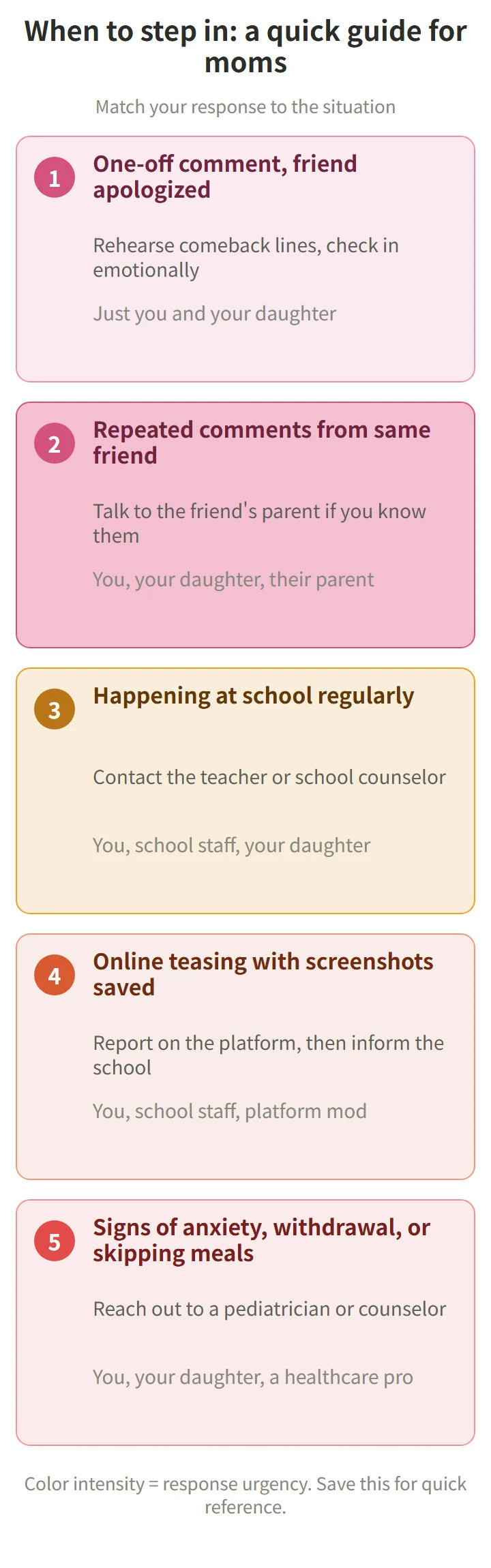
The real question isn’t “Is this technically bullying?” It’s “Is my daughter feeling safe and okay?” If the answer is no, it’s time to bring in help.
StopBullying.gov recommends telling a trusted adult as soon as teasing becomes repeated, intentional, or moves online. Asking for help isn’t tattling – it’s protecting your peace.
Rebuilding Confidence at Home That Night
The conversation doesn’t end when the teasing stops. What happens at home that same night matters just as much.
Start small. Ask her how she’s feeling – not about the incident, but about herself. Something like, “What was the best part of your day?” can shift the focus back to who she is, not what was said about her.
If she wants to talk about what happened, listen without jumping to fix it. If she doesn’t want to talk, that’s okay too. Sometimes a warm snack and a favorite show do more than a heart-to-heart.
Here are a few things you can try together:
- Remind her that every body grows at its own pace – there is no “right” timeline for Stage 2 changes
- Look at photos of her doing something she loves and talk about what her body can do, not how it looks
- Pick out a comfortable Suyiyi Stage 2 bra together so she feels supported and confident at school
According to HealthyChildren.org, parents who listen without minimizing the hurt help kids recover faster from teasing episodes. Your calm presence is the medicine.
Helping Your Daughter Help Herself
There’s a difference between preparing your daughter and putting the burden on her. She shouldn’t have to handle repeated teasing alone.
But giving her a few tools — a comeback line, a plan to walk away, a trusted adult she can name — builds a kind of confidence that lasts well beyond this one incident.
The National Center for Education Statistics found that 33% of students who reported being bullied said it was about their appearance. That’s a third of bullied kids hearing comments about their bodies, their size, their clothes, or their puberty changes.
Your daughter is not alone in this. And neither are you.
Frequently Asked Questions
What should my daughter say when a friend teases her about her body?
She can keep it short and firm: “Please don’t talk about my body” or “That wasn’t funny to me.” The goal isn’t to win an argument – it’s to set a boundary and walk away. Rehearse these lines together so they feel natural when she needs them.
How do I know if body teasing has crossed into bullying?
When comments happen repeatedly, are meant to hurt, spread online, or make your daughter feel unsafe at school, it may be bullying. StopBullying.gov defines bullying as unwanted, aggressive behavior that involves a real or perceived power imbalance and happens more than once.
Should I contact the school about a single comment?
One comment from a friend usually doesn’t require school involvement. But if it’s part of a pattern – same person, repeated incidents, or happening in class where a teacher could step in – reach out to the school counselor or your daughter’s teacher.
How can I help my daughter feel confident after body teasing?
Focus on what her body can do, not how it looks. Talk about her strengths, her hobbies, and the people who make her feel good. A warm, listening presence at home does more than any lecture. If the worry persists, consider talking with a pediatrician or counselor.
When should I seek professional help for body image concerns?
If your daughter starts avoiding school, skipping meals, talking negatively about her body often, or showing signs of anxiety, it’s time to talk to a healthcare professional. Early support makes a real difference.