
Shopping for an organic bamboo bra tween girls will actually keep on starts with one small flip of the tag. Your daughter says her bra itches. The label says “bamboo.” That sounds safe. On a clothing tag, that word does not mean what most moms think it means.
What “Bamboo” Really Means on a Tween Bra Tag
Here is the part most brands skip. Bamboo is a plant. Bra fabric is made from fiber. Turning that plant into soft cloth takes a factory, and most of those factories use chemicals.
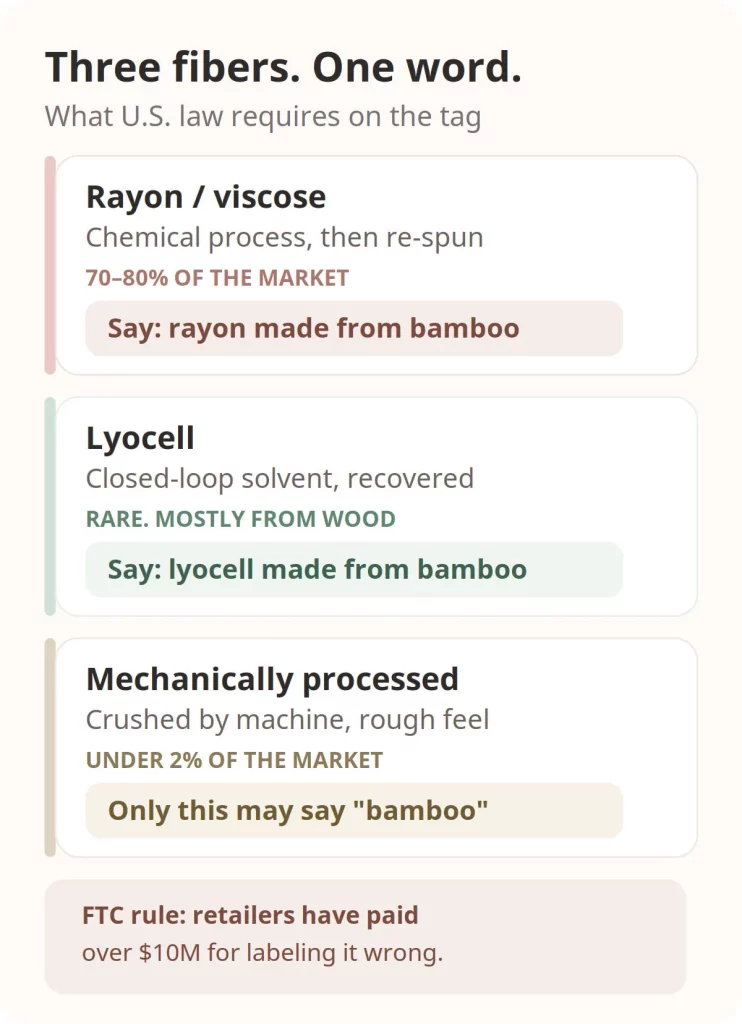
Three different fibers can come from bamboo, and only one of them is really bamboo fiber. Most tags say “rayon made from bamboo” or “viscose made from bamboo.” Those are regenerated fibers, made by dissolving the pulp and re-spinning it. Mechanically processed bamboo fiber is rough and scratchy, and nobody puts that next to a child’s skin.
U.S. law backs this up. The Textile Fiber Products Identification Act (16 CFR Part 303) requires the true fiber name on the tag. The FTC’s own page on bamboo textiles says a product can only be called “bamboo” if it is made from real bamboo fiber. Everything else has to say rayon made from bamboo.
Mom takeaway: if the bra is soft and silky, it is almost always rayon made from bamboo. That is not a bad thing. It is just not the plant.
Why the FTC keeps fining big stores over this one word
This is not a technicality brands get to shrug off. The FTC has gone after retailers again and again:
- 2010: warnings to 78 retailers, including Walmart, Target, and Kmart
- 2013: Amazon, Macy’s, Sears/Kmart, and Leon Max paid $1.26 million total
- 2015: Nordstrom, Bed Bath & Beyond, J.C. Penney, and Backcountry.com paid $1.3 million
- 2022: Kohl’s paid $2.5 million and Walmart paid $3 million
That last round was about bed sheets and housewares, not bras. The rule behind it is the same. A soft “bamboo” product is rayon, and calling it anything else breaks the law.
Is an “Organic Bamboo Bra” Actually Organic?
Short answer: usually not, at least not in the way the word sounds on a package.
Organic is a farm word, not a fabric word
USDA Organic can certify how the bamboo was grown. It does not cover what happens in the mill. To make viscose, the pulp is dissolved with sodium hydroxide and carbon disulfide, then re-formed in a sulfuric acid bath. Once that is finished, the plant is gone. What is left is regenerated cellulose, which counts as a manufactured fiber.
Why a 100% bamboo bra cannot be GOTS certified
GOTS (Global Organic Textile Standard) is the strictest organic label out there, and it has a math problem with bamboo. It requires at least 95% certified organic natural fiber for “organic” and at least 70% for “made with organic.” It counts bamboo viscose and bamboo lyocell as regenerated fibers instead of organic ones, and GOTS 7.0 groups regenerated fibers with virgin synthetics in one category capped at 10% of the product. The GOTS standard page lays out those fiber rules if you want to read them yourself.
So the numbers never add up for a 100% bamboo bra. If you see a GOTS logo on one, ask what that logo actually covers. It might cover a blend, a factory, or a different item in the line.
What to look for instead of the word “organic”
Stop hunting for “organic.” Look for these instead:
- The real fiber name. “Viscose made from bamboo” or “lyocell made from bamboo.” A tag that only says “bamboo” is a red flag.
- OEKO-TEX Standard 100. This tests the finished bra, including fabric, thread, elastic, prints, and labels, for more than 1,000 substances. Class II covers things worn next to skin, like a bra. Type the number into the OEKO-TEX Label Check and see if it is real.
- FSC certification. This means the bamboo came from a forest that is managed responsibly.
Why Fabric Choice Hits Tweens Harder Than Adults
A tween is not a small adult. Her skin is still changing, and that changes what fabric can do to her.
Her skin barrier is still under construction
Children have a thinner outer skin layer than adults, and a bigger surface area for their body weight. Both point to the same thing: young skin takes in more of whatever touches it. The National Eczema Association puts U.S. numbers at about 9.6 million children under 18 with atopic dermatitis, and roughly one in three of them has moderate-to-severe disease.
If that is your kid, fabric is not a small detail. It is either a daily trigger or a daily relief. Our guide to sensory-friendly clothing basics covers the same ground for the rest of her closet.
The underbust is a sweat trap
A bra band sits in one of the warmest, wettest spots on the body. Add a school day, the walk home, and gym class, and you get heat, sweat, and friction all in the same place.
Sweat changes the math. A 2025 study in Science of the Total Environment tested children’s clothing and found that sweat raised modeled skin absorption by up to 3,252 times for PFAS and 835 times for organophosphate esters compared with dry contact. PFAS showed up in 87.9% of the samples tested. That is not a scare tactic. It is a reason to care about what is left on the fabric.
Dyes cause more rashes than fiber does
When a rash shows up under a bra band, most moms blame the fabric. Research points at the dye first. A 2014 Italian study of 277 patients with textile contact dermatitis found that 58.3% of cases were allergic rather than simple irritation, and three dyes – Disperse Blue 124, Disperse Blue 106, and Disperse Yellow 3 – caused 79.8% of them. Half the patients reacted to more than one textile chemical at once. Children tested for textile dye allergy show sensitization rates of 3.1% to 4.6%.
Mom takeaway: color matters more than fiber. A light-colored, low-dye bra is usually the safer pick for a kid with reactive skin.
Bamboo vs. Organic Cotton for a Tween Bra — The Honest Scorecard
Bamboo is good at some things. It is not magic. There is also a lot of good research behind why sensory-friendly fabric behaves the way it does, and it backs up most of what you are about to read.
Where bamboo really wins
- It holds more moisture. Bamboo viscose takes in about 11–13% of its weight; cotton takes in about 7–8.5%. Sweat gets pulled off the skin before it feels wet.
- It feels smoother. The fiber is round and even, so there is less rubbing on tender skin.
- It drapes softly. It does not press or dig the way a stiff cotton knit can.
Where the marketing goes too far
- “It cools the skin.” Not really. A 2010 study by Gericke and van der Pol ran bamboo and cotton fabrics of the same construction on a thermal manikin and found no real difference in heat or water-vapor resistance. The cool feeling comes from the smooth surface.
- “It is antibacterial.” Settled question. In 2009, researcher Ian Hardin and his team bought “bamboo” products sold as antimicrobial from six different sources, tested them with AATCC Test Method 147 against Staphylococcus aureus and E. coli, and none of them worked. The plant’s natural antimicrobial compound, often called “bamboo kun,” does not survive the chemical process. Do not pay extra for odor control unless the brand names the finish and shows the test.
- “It is fully eco-friendly.” Conventional viscose uses carbon disulfide, a real workplace hazard. Bamboo lyocell is the cleaner path, with a closed-loop system that recovers more than 99% of its solvent and skips carbon disulfide entirely.
Where cotton wins
- It is stronger when wet. Viscose keeps only about 50–55% of its dry strength when wet; cotton gains strength.
- It handles hot washes. Tween sports bras need frequent washing, and bamboo viscose needs cool water and gentle drying or it shrinks and pills.
- It can be GOTS certified. Bamboo cannot.
The sleeper pick: modal, bamboo’s cousin
Modal sits in the same fiber family as bamboo viscose. Both are regenerated cellulose, so both are soft, smooth, and sweat-friendly. Both fail the GOTS organic math for exactly the same reason.
Modal wins on the three things that actually bite moms. It is a high-wet-modulus fiber, so it keeps far more of its strength in the wash instead of going limp the way standard rayon does. It shrinks less and pills less, which matters when a bra goes through the laundry twice a week. And “modal” is the fiber’s real name, unlike “bamboo,” which always needs an asterisk next to it.
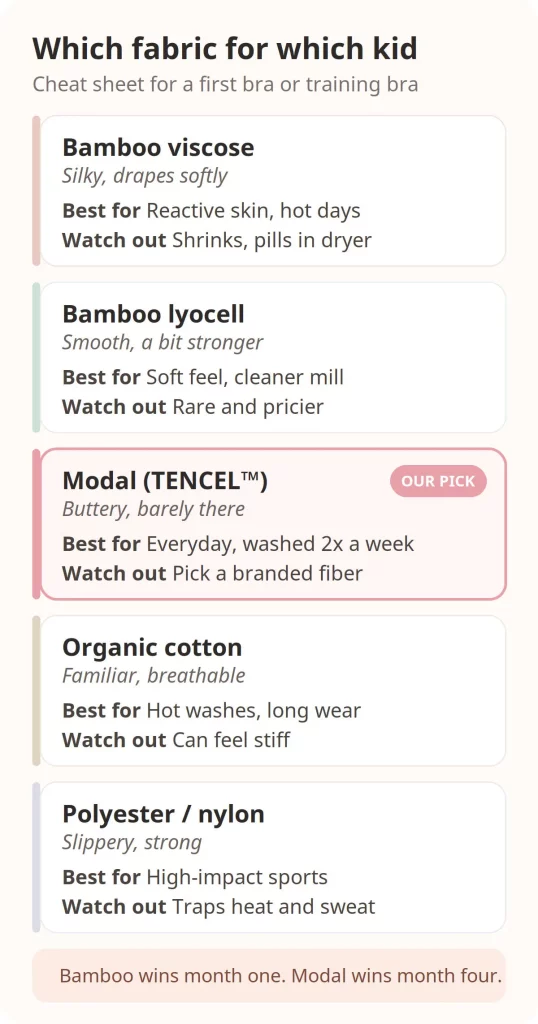
Here is the short version, laid out for a phone screen:
Mom takeaway: bamboo viscose is lovely for the first month. Modal is still lovely in month four, after twenty washes.
Why Suyiyi Builds Stage 1 Bras in TENCEL™ Modal
We are not going to call our bras organic. They are made from regenerated cellulose, and as you just read, regenerated fibers cannot be certified organic under GOTS. Claiming otherwise would be the same “bamboo” trick this article is about.
What we will tell you is what the fiber is and where it comes from. Our Stage 1 everyday styles are built in TENCEL™ Modal, a branded fiber made from beech wood sourced from FSC- and PEFC-certified forests. A branded fiber like this is traceable back to the mill, and that mill runs a closed-loop process that recovers most of the solvents instead of dumping them. That is a claim with a paper trail, not a leaf printed on a package.
It also feels like nothing on. TENCEL™ Modal holds about 50% more moisture than cotton, so sweat moves off her skin instead of pooling under the band. The fiber is fine and round, which is why seamless, tag-free modal bras are such a common pick for sensory-sensitive kids.
Here is how we think about fabric by stage. Stage 1 (ages 8–11) is new skin, so softness and coverage come first, and a light, bonded modal style like the BreezyBare Bra keeps the first few weeks easy. Stage 2 (ages 12–15) brings fast growth and more sweat, so look for modal with more stretch plus a wider, softer band. Stage 3 (ages 16–18) is about all-day comfort, where durability counts as much as softness and a cotton-rich blend with a smooth modal lining tends to last longest.
One more thing that shows up around month two: pilling. Bamboo viscose fuzzes fast once it hits a dryer. The modal knit we use on the BreezyBare Bra is built with a finer, anti-pilling finish, and that is often the difference between a bra she tolerates and one she forgets about.

The 6-Point Label Check for Moms
Use this at the store or in the cart. It takes about two minutes.
- Read the fiber line. It should say “viscose made from bamboo,” “lyocell made from bamboo,” or “modal.” A tag that says only “bamboo” is a warning sign.
- Find the OEKO-TEX number. No number? Ask the brand.
- Check the product class. Class I is for babies and toddlers up to 36 months. Class II is right for bras and other next-to-skin items.
- Look at the color and trim. Dark dyes, printed elastic, and glued seams add chemical load. Simple is safer.
- Ignore “hypoallergenic.” There is no legal definition of that word for textiles. It means nothing on its own.
- Wash before the first wear. One wash removes a real share of surface residues. Use a fragrance-free detergent and skip the fabric softener.
Budget-Friendly Ways to Test the Fabric First
You do not have to rebuild her whole drawer. Start with one bra and watch what happens.
Buy one modal bra in a light color and let her wear it for a week. Our BreezyBare Bra is $30 and comes in white, blue, and neutral, so a low-dye color is easy to find. If the redness under her band fades by Friday, you have your answer.
Two more wins that cost nothing: wash new bras in cold water with a fragrance-free detergent, and air-dry instead of tumble-drying. Both cut down on skin complaints. If the fabric pills or the band stretches out fast, note it. Wear over a month tells you more about quality than any label does.
How to Talk to Your Daughter About It
Keep it small and calm. Try: “Let’s find the one that feels best on you.” Then let her pick between two options you have already checked. She gets control without getting overwhelmed.
If she has redness that will not clear, ongoing itching, or a rash that keeps coming back, that is not a shopping problem. That is a doctor problem. Please see a pediatrician or a dermatologist.
FAQs
Is an organic bamboo bra tween girls with sensitive skin need really worth the price?
Sometimes. Pay for softness and moisture handling, not for the word “organic.” A bamboo-blend bra with an OEKO-TEX number is worth more than a pricier one with a green leaf on the package and no certification behind it.
Will bamboo fabric cure my daughter’s eczema?
No. Fabric cannot cure eczema. Soft, low-dye, certified fabric can cut down on daily rubbing and sweat irritation, which helps a lot of kids feel better. It is not a treatment.
Why does the rash show up only under the bra band?
That spot holds heat, sweat, and friction at the same time, and sweat also raises how much skin absorbs from fabric. Dyes and finishes on the elastic are common culprits, so try a lighter color and a wider, softer band.
How often should I replace a tween bra?
Plan on every 6 to 9 months during a growth spurt, sooner if the band stretches out or the fabric pills. Washing on cool and air-drying buys you more time with bamboo blends.
Is bamboo lyocell better than bamboo viscose?
For the planet, yes. Its closed-loop process recovers more than 99% of the solvent and avoids carbon disulfide. On the skin, they feel close to the same.
Is modal the same thing as bamboo?
No, but they are close relatives. Both are regenerated cellulose made in a mill. Bamboo viscose is softer out of the package and drapes beautifully. Modal holds its shape and strength through repeated washing, so it usually looks better after a season of real use.
Why doesn’t Suyiyi make bamboo bras?
Two reasons. Most “bamboo” fabric is rayon, and we would rather print the fiber’s real name on the tag than lean on a plant name that needs an explanation. Modal also survives the washing schedule a tween bra actually gets.
The Bottom Line
Bamboo is a good fabric for a tween bra. It is soft, it handles sweat well, and it is gentle on skin that reacts easily. It is not organic, it is not antibacterial, and it is not a cure for eczema. Modal comes from the same fiber family, and it trades a little of that first-day drape for a bra that still feels right after twenty washes.
Pay for the certification, not the story. Ask for the fiber name, not the plant name. Check the dye and the trim, not just the front of the package. That is the whole test for an organic bamboo bra tween girls will actually keep on.